
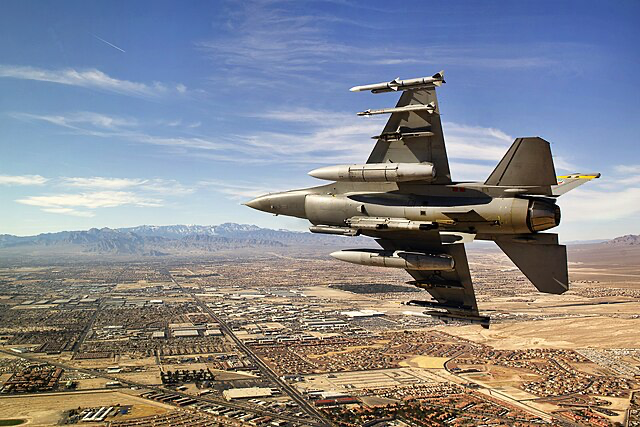
The F-16 fighter jet, also known as the F-16 Fighting Falcon or the Viper, is a long-running single-engine aircraft. As one of the world’s most iconic fighters for air-to-air combat and air-to-surface attack, the F-16 has a successful military jet development. It has evolved from being an air superiority fighter to a multi-role aircraft that remains in use today by the US and its allied partners. Learn the history behind the F-16, its design and performance, and how it remains an enduring legacy in the air force.
Origins of the F-16 Fighter Jet
The first F-16 was a single-seat, single-engine jet fighter developed by the General Dynamics Corporation towards the end of the war in Vietnam, when the Soviet Mikoyan-Gurevich (MiG) overwhelmed heavier and slower US fighter planes. The United States and four NATO countries, namely Belgium, Denmark, the Netherlands and Norway, agreed to produce a lightweight, highly maneuverable, and cost-effective air-to-air fighter in 1972. The long-term benefits of this program was technology transfer among the agreeing nations, and a common-use aircraft for NATO nations.
The resulting F-16 was assembled from components manufactured in all five countries, and took its first flight in 1974. In January 1979, the first operational F-16A was delivered to the 388th Tactical Fighter Wing at Hill Air Force Base, Utah.
Today, the F-16 is one of the world’s most widely used fighters, with over 4,500 aircraft having been built, operating in 29 countries.The jets are currently manufactured by Lockheed Martin, a US defence and aerospace manufacturer, which took over production in 1995. Current models are all-weather capable and effective for ground attack.
Design and Capabilities
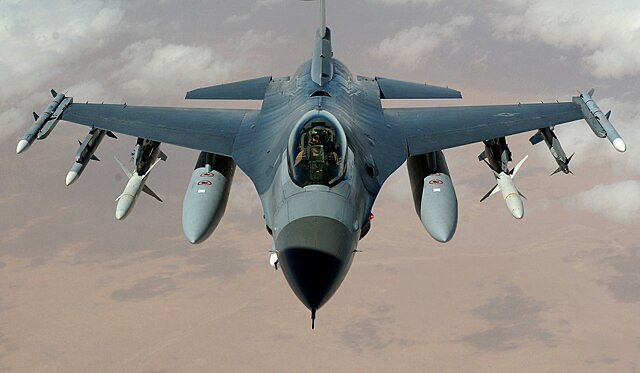
The F-16 entered operational service in January 1979, when the first F-16A was delivered to the 388th Tactical Fighter Wing at Hill Air Force Base in Utah. Designed from the outset as a lightweight yet highly capable fighter, the aircraft introduced several innovations that set new standards in modern combat aviation.
Here are the details of the F-16’s design and capability:
- Length: 49 feet (15 meters)
- Wingspan: 31 feet (9.45 meters)
- Powered by: single turbofan engine, the Pratt and Whitney F100-PW-200/220/229
- Thrust output: 23,000–29,000 lb (102–130 kN) with afterburner
- Wing material: Aluminum-alloy for improved lift and stability
- Internal 20-mm rotary cannon
- Multiple hardpoints under wings and fuselage for bombs and missiles
- Approximate combat weight: 23,000 lb (10,000 kg)
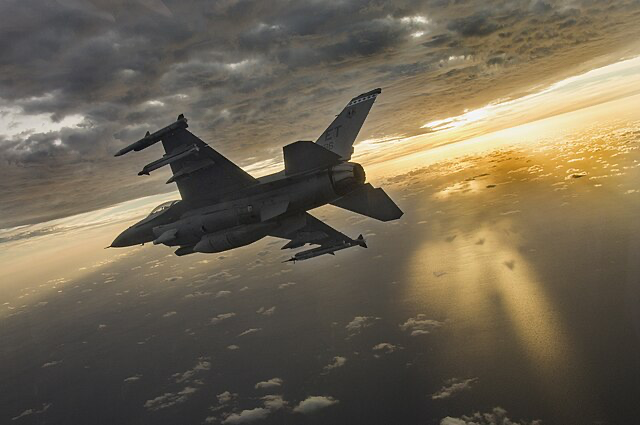
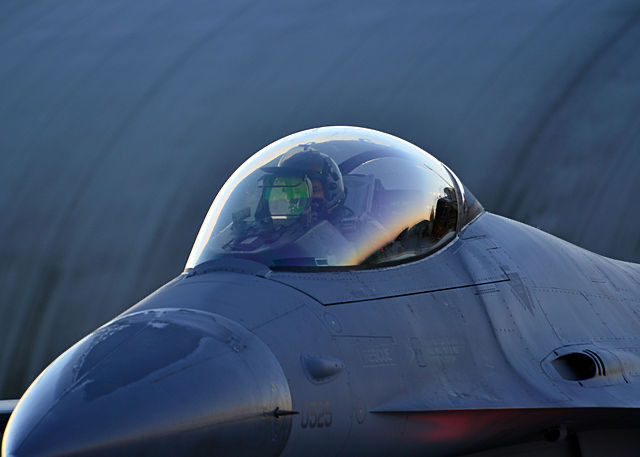
The fuselage of the F-16 also has a computerized stabilizing system that issues continuous commands to control surfaces in the tail and wings, together with an instrumentation system to display flying and combat data onto a transparent screen in front of the pilot. It can use laser range-finder processing to aim bombs with high accuracy from low altitudes, making it a highly capable and versatile aircraft.
The original F-16A was a single-seat aircraft, while the F-16B served as a two-seat version with a pair of cockpits and a bubble canopy that stretched to cover the second cockpit. During training, a student pilot occupies the forward cockpit while the instructor stays in the rear cockpit.
Since November 1981, all F-16 models have built-in structural and wiring features that support precision strike, night attack, and beyond-visual-range interception missions. This improvement program was realized in the F-16C and F-16D aircraft, which include the latest cockpit control and display technology. All active units and many of those in the Air National Guard and Air Force Reserve have converted to the F-16C/D.
How Fast Is an F-16 Fighter Jet?
The F-16 is known for its speed and agility. It was the first production fighter aircraft specifically designed to sustain 9-g maneuvers, giving it superior capability. Powered by a single turbofan engine and supported by its fly-by-wire control system, the aircraft can reach a maximum speed of over Mach 2 at an altitude of 40,000 feet, which equals to approximately 1,500 miles per hour.
This combination of speed, acceleration, and maneuverability allows the F-16 to excel in both air-to-air combat and rapid-response strike missions, making it one of the most agile fighters of its generation.
Performance in Combat
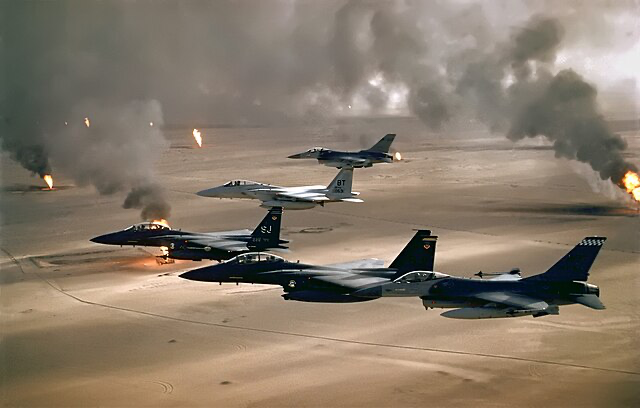
Throughout its service history, the F-16 has established a strong combat record, demonstrating its versatility in both the air-to-air role (with a 76-to-1 kill ratio) and the air-to-ground role. The F-16 models have been sold to US allies in the Middle East, where it has been used in air-to-air combat and ground attack in the Israeli-Syrian conflict of 1982 as well as the Persian Gulf War of 1990–91. This fighter jet has also been deployed in nearly every major US military conflict. Here is a look at five of the F-16’s notable combat engagements in history.
1. Lebanon War (1982)
The F-16’s combat reputation was firmly established during the Lebanon War, where Israeli Air Force Falcons dominated Syrian aircraft during Operation Mole Cricket 19. F-16s reached 44 air-to-air kills, primarily against MiG-21s and MiG-23s. One aircraft reportedly downed four enemy fighters in a single sortie, cementing the F-16’s status as a lethal air superiority platform.
2. Operation Desert Storm (1991)
During the first Gulf War, the F-16 became the most heavily used US fighter aircraft. Flying up to 400 sorties per day, F-16 conducted precision strikes, suppression of enemy air defenses, and close air support missions. The F-16 also led the first daylight attack on Baghdad, showing its versatility and reliability in large-scale, high-intensity conflict.
3. Iraqi MiG-25 Shootdown (1992)
While enforcing Iraq’s no-fly zones under Operation Southern Watch, an F-16 shot down an Iraqi MiG-25 using the Air Intercept Missile-120 (AIM-120) Advanced Medium-Range Air-to-Air Missile (AMRAAM), marking both the first F-16 air-to-air kill by the US Air Force and the first combat kill using the AMRAAM missile.
4. Bosnia-Herzegovina No-Fly Zone Enforcement (1994)
In March 1994, two United States Air Force (USAF) F-16s enforcing a UN-mandated no-fly zone over Bosnia shot down four Serb aircraft after they ignored multiple warnings. This marked NATO’s first offensive combat action in its history and the first triple aerial kill since the Korean War, underscoring the F-16’s effectiveness in multinational operations.
5. Protection of British Special Forces (2003)
During the early stages of the Iraq War, two F-16s saved 52 British special operators who were surrounded by Iraqi forces. Using a low-altitude supersonic flyover, an F-16 broke the sound barrier near enemy troops, causing confusion and forcing them to retreat. The maneuver allowed the trapped operators to escape without direct engagement.
How Much Does an F-16 Cost?
Having been in production for so long, F-16 prices have changed over the years. Executive Flyers found that the early F-16A and F-16B variants sold in the early 1980s for around $13 million. The improved F-16C and F-16D variants sold for close to $20 million. Meanwhile, newer variants, the F-16E and F-16F command a starting price of $25 to $30 million. Further improvements and equipment may even increase the price further to a range of $60 to $70 million.
The Current State: Evolution and Legacy
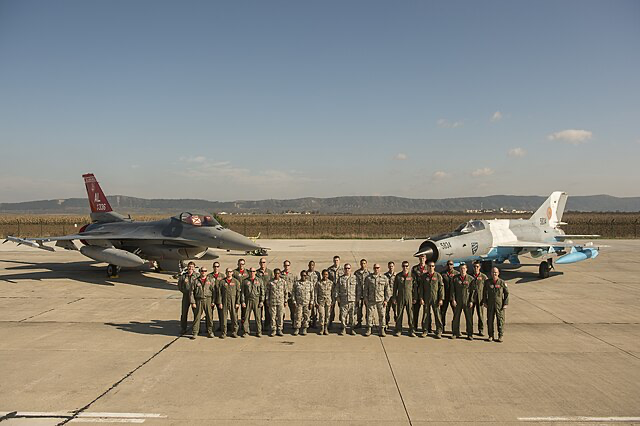
Over the decades, the F-16 has undergone continuous upgrades to secure its place along 5th-generation jets such as the F-35. Key upgrades include:
- Enhanced avionics, radar, and weapons integration for F-16C/D Block 50/52.
- Addition of Army-Navy, Airborne, Pulse-Doppler, Fire-Control Radar-83 (AN/APG-83) active electronically scanned array (AESA) radar, upgraded mission computers, modern cockpit displays, advanced electronic warfare systems, and a structural life extension program (SLEP) to 12,000 flight hours for the F-16V “Viper” Upgrade.
- Weapons integration to be compatible with Air Intercept Missile-120 (AIM-120) Advanced Medium-Range Air-to-Air Missile (AMRAAM), AIM-9X Sidewinder, Joint Direct Attack Munitions (JDAMs), and precision-guided munitions.
Although considered older than other fighters that the US has, F-16 fighter jets remains strategically valuable due to a number of reasons:
Affordability
The operating costs of F-16s are significantly lower than stealth fighters, allowing for high-volume training and cost-effective mission deployments where stealth is not required.
Flexibility
The F-16 excels at versatile roles, including air policing, close air support, and precision strike.
Global Reach
With over 25 allied and partner nations operating the F-16, it is widely used for international coalitions. This common platform simplifies joint training, logistics, and combined operations across NATO, the Middle East, and Asia.
Bridge to the Future
Extending the service life of modernized F-16s ensures the US maintains airpower capacity and pilot proficiency while scaling up the F-35 and next-generation programs.
Why the F-16 Remains One of the Most Successful Fighter Jets Today?
Analysts project that F-16 jets will remain in the US and its and allied partners’ inventories until at least the mid-2040s. In this role, the F-16 is not just a historic fighter, but an enduring and adaptable aircraft. Its lasting success of the F-16 lies in its continuous modernization and ability to stay relevant in an ever-evolving aerospace landscape. Newer variants, such as the F-16V, are attracting the interest of countries such as Bahrain, Bulgaria, and Greece. As it marks more than 5 decades of service, the F-16 Fighting Falcon remains a legacy that will continue to shape modern air forces for decades to come.