
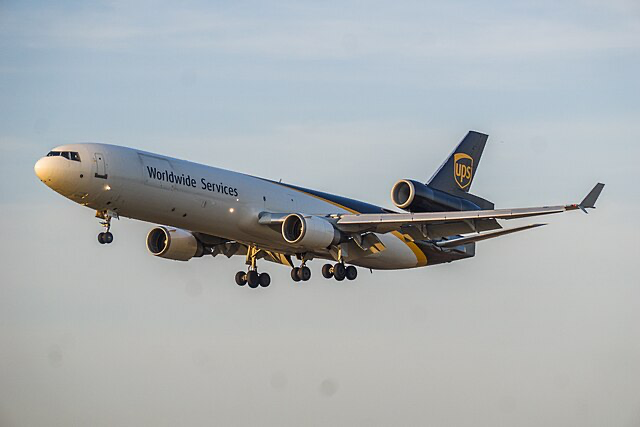
On November 4, 2025, a Boeing (McDonnell-Douglas) MD-11F airplane flying as United Parcel Service (UPS) flight 2976 was destroyed after impacting the ground shortly after takeoff from Louisville Muhammad Ali International Airport (SDF), Louisville, Kentucky, killing 14 people in the fatal crash.
Crash Details
Flight 2976 was a domestic cargo flight from SDF bound for Daniel K. Inouye International Airport (HNL), Honolulu, Hawaii. The freighter itself was a 34-year-old jet.
All the crew onboard had deep MD-11 experience, with the following details:
- Captain: 8,613 total hours, 4,918 on type
- First Officer: 9,200 hours, 994 on type
- Relief Officer: 15,250 hours, 8,775 on type
The plane received takeoff clearance at about 17.11 EST. The taxi and takeoff roll went as routine. The airplane rotated for takeoff at approximately 17.14 EST. It started its climb, but did not get higher than about 30 ft above ground level. The plane cleared the blast fence beyond the end of runway 17R, but its left main landing gear struck the roof of a UPS Supply Chain Solutions warehouse at the southern edge of the airport.
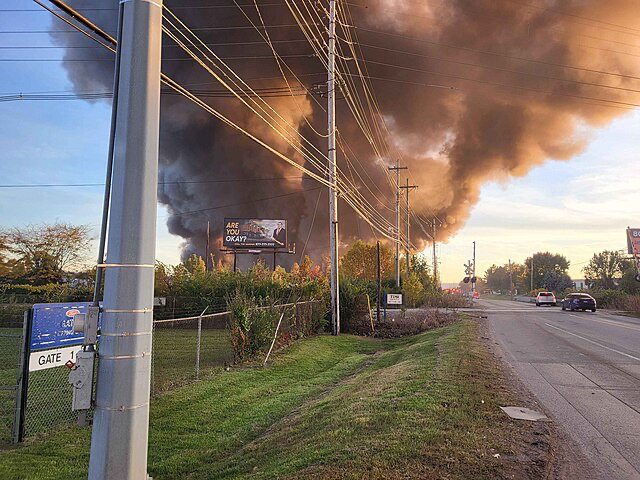
The Flight 2976 accident also impacted a storage yard and two additional buildings on the other side of the fence, including a petroleum recycling facility, mostly consumed by fire.
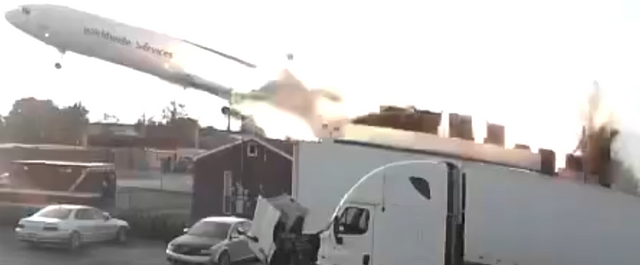
A witness in the control tower reported that the plane had normal takeoff speed, but the climb was not. Another witness added about how the plane stopped climbing and started to lose altitude before rolling to the left.
According to Louisville’s mayor, Craig Greenberg, the aftermath was “unlike anything the city has seen in decades". In the most recent statement released by UPS on November 20, 2025 at 11:00 AM, UPS stated:
“We continue to grieve for the lives lost in the tragic accident involving Flight 2976. Before the FAA issued its Emergency Airworthiness Directive for all MD-11 operators, UPS proactively grounded its MD-11 fleet out of an abundance of caution. We appreciate the National Transportation Safety Board’s prompt release of preliminary findings and will fully support the investigation through its conclusion."
Casualties and Survivors of UPS Airlines Flight 2976
The NTSB Flight Investigation Report has released the following details about the injuries and damage from the UPS cargo plane accident:
- Crew Injuries: 3 Fatal
- Ground Injuries: 11 Fatal, 2 Serious, 21 Minor
- Total Injuries: 14 Fatal, 2 Serious, 21 Minor
- Aircraft Damage: Destroyed
- Aircraft Fire: Both in-flight and on-ground
- Aircraft Explosion: None
Investigation and Early Indicators
UPS Airlines Flight 2976 involved the MD-11, which is a three-engine widebody passenger airplane manufactured by McDonnell-Douglas. At the time of the accident, the airplane had accumulated a total time of about 92,992 hours and 21,043 cycles, in which one cycle refers to one takeoff and one landing. The Federal Aviation Administration (FAA), UPS, The Boeing Company, Independent Pilots Association (IPA), General Electric (GE) Aerospace, and Teamsters Airline Division were invited as part of the investigative process.
Key Findings From Recorded Flight Data and Surveillance
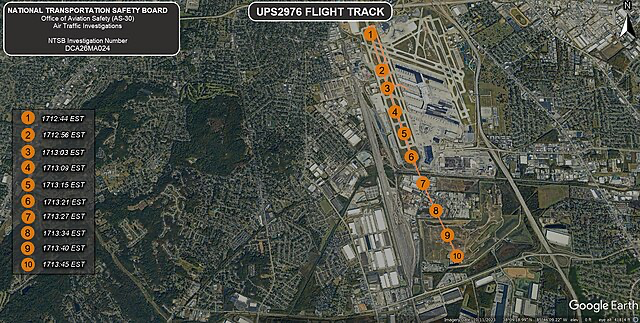
The plane’s CVR stored about 2 hours and 4 minutes of recording, while the FDR contained about 63 hours of data from 24 flights, including this accident. The recordings showed that the accident flight started about 17.07 EST, with takeoff starting about 17.12. The flight data ended at approximately 17.13.
The plane’s airport surveillance video showed the left engine and pylon separating from the wing shortly after rotation, followed by a fire igniting on the detached engine as it passed over the fuselage. Afterwards, a second fire ignited near the left pylon attachment to the wing, and continued until the airplane impacted the ground.
Discoveries from Wreckage Examination
The wreckage was spread over a wide area, and most of it was significantly fragmented and burned. Findings on and adjacent to runway 17R identified the left engine, left pylon with its forward and aft mounts, fragments of engine fan blades, and separated pieces from the left engine. These portions were successfully recovered for further analysis.
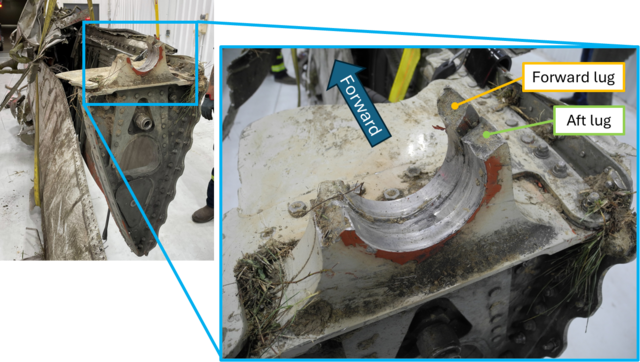
Unlike the left engine, the right engine was still attached to the right wing pylon. Both were recovered at the accident site. The forward and aft mounts, however, had separated from the wing pylon, and were found about 87 ft away.
Examination of fractures from the left pylon aft mount lug after cleaning the debris revealed fatigue cracks as well as areas of overstress failure. A fatigue crack was discovered where
the aft lug bore met the aft lug forward face. There were no indications of deformation or pre-existing fractures at the forward top flange of the aft mount assembly.
Maintenance and Inspection
Maintenance data have also been collected from San Antonio,TX (USA), where the plane had undergone maintenance for several weeks.
A general visual inspection (GVI) and a detailed visual inspection of the left pylon aft mount was last made on October 28, 2021, while lubrication of the pylon thrust links and pylon spherical bearings was last accomplished on October 18, 2025.
Aftermath of UPS Airlines Flight 2976
As a precautionary measure and at the recommendation of Boeing, UPS grounded both MD-10 and MD-11 series fleets to undergo a thorough inspection based on an Emergency Airworthiness Directive (AD) from the FAA. This was due to the MD-10 having a similar design as the MD-11.
Similarity to DC-10 crash in Chicago, 1979
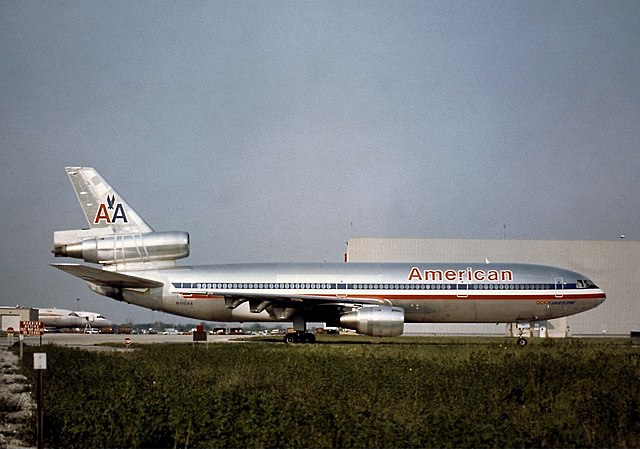
The Flight 2976 accident shares similarities to a 1979 crash in Chicago that involved American Airlines Flight 191 which killed nearly 300 people. This crash also involved the left engine and pylon along with part of the left wing separating from the plane, causing it to fall to the runway. The plane then crashed into an open field. NTSB’s report identified human error from maintenance personnel as a likely contributor to the accident.
What Can We Learn from UPS Airlines Flight 2976?
NTSB investigators are still gathering more information for the Flight 2976 accident, with a final report expected to be released in 18 to 24 months showing more detail on probable causes of the crash. Early findings from the investigation showed that the plane’s left engine and pylon separated shortly after takeoff, triggering fires that continued until impact. Data from the CVR, FDR, and airport surveillance, along with scattered wreckage, revealed evidence of fragmentation and fatigue cracking in the left pylon aft mount.
Historically, cargo planes have had a higher accident rate per flight compared to passenger planes due to receiving less frequent upgrades and having less strict regulations on pilot fatigue. However, it is important to remember that accidents are still considered extremely rare. Accident investigation plays a vital role in understanding the full story behind every accident and improving global aviation safety.
With continuous improvements in aviation technology, stricter regulations, and more rigorous pilot training, air cargo companies and air freight carriers continue to ensure that aviation remains a safe and trusted mode of transportation.