
The aviation industry continues to conquer the skies with aircraft of spectacular sizes. For more than five decades, one of the biggest aircraft remains the first twin-deck jumbo jet stretching over 76 meters long and capable of carrying more than 660 passengers, followed by an impressive list of various other planes for commercial, cargo, and military purposes. Each plane represents the peak of technology and innovation, serving various purposes from commercial, cargo, to military aircraft. As new records are set, the list continues to evolve. Let us take a look at the world’s 10 largest aircraft, ranked in this 2026 update.
10. Kunlong

Most recently, the title of the world’s largest operational seaplane belongs to China’s AG600 Kunlong. Developed by the Aviation Industry Corporation of China with its first flight in 2017, this massive amphibious aircraft measures approximately 36.9 m (121 ft) in length with a 39.3 m (129 ft)-wingspan, roughly the size of a Boeing 737.
Powered by four WJ-6 turboprop engines producing 4,500 horsepower each, it combines significant range, payload, and water-operational capability, able to fly about 4,023 km (2,700 miles) while carrying up to 50 passengers. The Kunlong is the largest working seaplane today, serving dual civilian and military roles in firefighting, marine rescue, and transport missions.
9. Tupolev Tu-160

The Tupolev Tu-160, also known as the Blackjack, is the largest and fastest supersonic combat aircraft ever built. Measuring 54.1 m (177.5 ft) in length with a variable-geometry wingspan reaching 55.7 m (183 ft) when fully spread, this bomber holds multiple records, including the largest combat aircraft, largest supersonic aircraft, and largest swept-wing aircraft in the world.
Designed by the Soviet Union as a long-range stand-off missile platform, the Tu-160 took its first flight in 1981. It is also often visually compared to the American B-1 Lancer, although it belongs to a heavier, more powerful class. It has the heaviest maximum takeoff weight of any combat aircraft, and one of the largest payload capacities among active heavy bombers. It is currently still in service with the Russian Air Force, having been renewed with the modernized Tu-160M2 variant that rolled out in 2017.
8. Antonov An-124

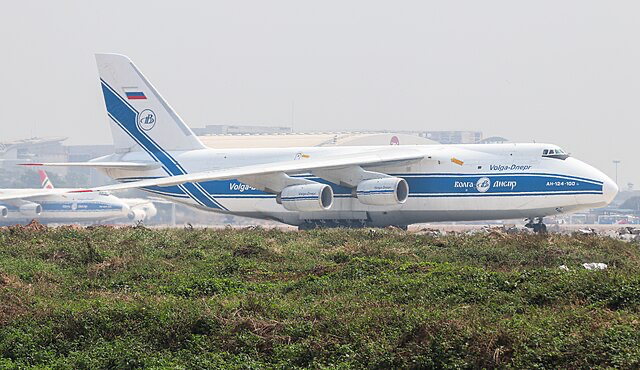
After the destruction of the Antonov An‑225 Mriya in February 2022, the Antonov An‑124 Ruslan is the largest cargo aircraft in operation. It has a payload capability of around 150 tons, and dimensions of 69 m (226 ft) in length and 73.1 m (ft) in wingspan. Specifically designed to carry heavy loads, it is one of the most capable and active transport aircraft today, equipped with drive-on loading ramps and various built-in freight handling equipment.
7. Stratolaunch Roc

Inspired by the legendary bird of prey from Arabian folklore, the Stratolaunch Roc is the world’s largest aircraft by wingspan, measuring 117 m (384 ft), and a length of 72.5 m (238 ft). This experimental launch platform, with its distinctive twin-fuselage design joined by a massive center wing, is powered by six Boeing 747 engines and weighs over 590,000 kilograms at maximum takeoff. Originally built as a mothership to launch satellites into low Earth orbit, the Roc is now being retooled following an ownership change to serve as a premier platform for high-speed hypersonic flight testing, capable of carrying payloads of up to 250 tons.
6. Airbus A380‑800

The Airbus A380-800 remains the world’s largest passenger aircraft in terms of both physical dimensions and cabin volume. With a length of 72.7 m (238.5 ft) and a 79.2 m (260 ft)-wingspan, this double-deck Superjumbo accommodates up to 853 passengers in a high-density configuration. It is powered by four Engine Alliance GP7200 or Rolls-Royce Trent 900 engines, cruising at Mach 0.85 with a long-haul range of roughly 14,816 km (9,206 miles).
First flown in 2005 and entering service with Singapore Airlines in 2007, the A380 plane was Airbus’ answer to the Boeing 747. Despite production ending in 2021 with 251 aircraft delivered, no other larger passenger aircraft has entered service. Emirates is now its largest operator, ensuring the aircraft’s presence well into the future.
5. Airbus A350 Extra Wide Body (XWB)
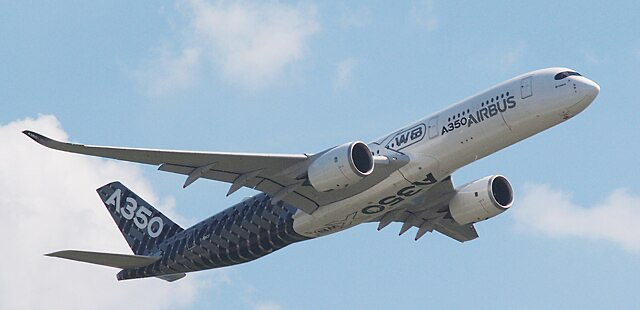
The Airbus A350 XWB is a next-generation, ultra-long-haul widebody airliner designed to combine size, efficiency, and range at the highest level of modern commercial aviation. As Airbus’ first aircraft built extensively using carbon-fiber-reinforced polymers, it has a lighter, stronger airframe suitable for long-distance operations. It is powered by advanced Rolls-Royce Trent XWB turbofan engines, producing up to 84,200 lbf of thrust on the A350-900 and 97,000 lbf on the larger A350-1000 for exceptional performance and fuel efficiency.
Dimensionally, the A350-1000 variant has a length of around 73.8 m (242 ft), making it one of the longest airliners in production and comparable in size to the Boeing 777. It first flew in 2016 and entered service with Qatar Airways in early 2018. With seating capacities of up to 480 passengers, this plane is among the world’s largest and most capable long-haul aircraft.
4. Lockheed C-5 Galaxy

First flown in 1968, the Lockheed C-5 Galaxy stands as one of the largest military aircraft ever built and remains the backbone of U.S. strategic airlift operations. Measuring approximately 75.3 m (247 ft) in length with a wingspan of 67.89 m (222.7 ft), the C-5’s immense proportions allow it to transport oversized and heavy military equipment that no other aircraft can match over comparable distances.
For decades, the C-5 has played a vital role in global military operations, including sustaining coalition forces during Operation Desert Storm, becoming a cornerstone of American power projection worldwide. As the U.S. Air Force’s largest and only true strategic airlifter, this aircraft can carry oversized and heavy military equipment at further distances compared to other military aircraft. It is capable of airlifting up to six MRAP vehicles, multiple helicopters, or even two M1 main battle tanks with an operational range of around 11,000 km (6,835 miles).
3. Airbus A340

The Airbus A340 is a long-range, wide-body airliner that launched with Lufthansa (LH) and Air France (AF) in 1993. Developed with A300 as the base model, its early variant was propelled by CFM56s, while later variants are powered by the RR Trent 500 engine, which gives 248.12–275.35 kN of thrust. The A340-600 can accommodate up to 475 passengers, stretching to roughly 75.4 m (247.5 ft).
After delivering 377 A340s, the company announced in 2012 it would stop the production of the aircraft, shifting resources for more A350s. Despite halted productions, many airlines are still operating this aircraft, with around 200 still in service, and LH is the largest operator.
2. Boeing 777

In second place, we have the Boeing 777, the world’s largest and most successful twin-engine, long-range wide-body airliner. First flying in 1994 and entering service in 1995, it pioneered long-haul point-to-point travel and has been delivered over 1,700 times to major carriers like Emirates and United Airlines. Its classic variants are powered by powerful turbofans from General Electric, Pratt & Whitney, and Rolls-Royce, while the next-generation 777X will be propelled by the revolutionary GE9X, the world’s most powerful turbofan engine.
The family includes models ranging from the original 209-foot 777-200, seating about 440 passengers, to the extended 73.8 m (242 ft) 777-300ER, accommodating up to 550. The latest series, 777X, entered service in late 2025, continues the lineage with advanced efficiency and a typical capacity of around 426 passengers in a two-class layout with a length of over 76.2 m (250 ft).
1. Boeing 747
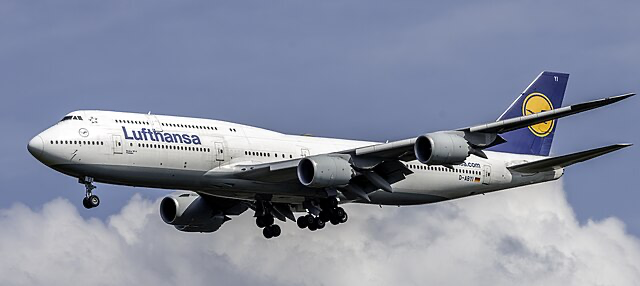
Affectionately known as the “Queen of the Skies,” the iconic Boeing 747, at number one, is the world’s first twin-deck airliner built to meet the growing worldwide demand for air travel in the 1960s. Designed by Joe Sutter and first flown in 1969, this long-range aircraft is instantly recognizable by its distinctive hump and semi-double-decker design. Across its variants, which include the original 747-100 and the final 747-8, its dimensions and capabilities evolved significantly, with lengths extending up to over 76.3 m (250 ft, 2 in) and ranges reaching nearly 14,816 km (9,206.2 miles). Powered by a series of engines from Pratt & Whitney, General Electric, and Rolls-Royce, it could carry from 400 to over 660 passengers at near-supersonic speeds.
After an impressive 54-year production run with 1,574 aircraft, the final 747 was delivered to Atlas Air in January 2023, marking the end of an era for the pioneering jumbo jet. Although production ended in 2023, hundreds of Boeing 747s remain active globally for cargo and a few passenger airlines such as Lufthansa, Korean Air, and Air China.
Below is a table that summarizes the world’s 10 biggest aircraft rankings based on their length, from the largest:
| Aircraft | Length |
|---|---|
| 1. Boeing 747 | 76.3 m (250 ft, 2 in) |
| 2. Boeing 777 | 76.2 m (250 ft) |
| 3. Airbus A340 | 75.4 m (247.5 ft) |
| 4. Lockheed C-5 Galaxy | 75.3 m (247 ft) |
| 5. Airbus A350 Extra Wide Body (XWB) | 73.8 m (242 ft) |
| 6. Airbus A380-800 | 72.7 m (238.5 ft) |
| 7. Stratolaunch Roc | 72.5 m (238 ft) |
| 8. Antonov An-124 | 69 m (226 ft) |
| 9. Tupolev Tu-160 | 54.1 m (177.5 ft) |
| 10. AG600 Kunlong | 39.3 m (121 ft) |
Serving various purposes such as strategic military airlifters and ultra-long-haul commercial flagships, this world’s largest aircraft ranking highlights planes built to push physical and technological limits. Icons like the A380 plane continue to define high-capacity passenger travel, while long-range workhorses such as the Boeing 777 prove that size and efficiency can coexist at scale. As engineering advances and new designs emerge, prepare to see how the definition of “biggest” will keep evolving.